

International scientific research platform · 2026
An experimental architecture for solar energy.
Optics, engineering and international scientific collaboration.
HeliosReflect investigates a new solar concentration architecture capable of managing solar energy simultaneously across multiple uses: electricity, heat, light transport and photochemical processes. An open research platform for universities, technology centres and scientific collaborators.
HeliosReflect
Four questions, one starting point
Before talking about technology, it is worth understanding the challenge. HeliosReflect exists because the questions it wants to answer do not yet have a demonstrated answer.
What is HeliosReflect?
An open research platform investigating a new solar concentration architecture able to manage solar energy across multiple simultaneous uses: electricity, industrial heat, light and photochemical processes.
Why does it exist?
Because current solar plants use a fraction of the incoming radiation, and the rest is reflected or dissipated. Research in optical concentration opens new possibilities for managing that energy.
Why does it matter?
Because solar concentration can potentially feed industrial heat processes, fibre optic light transport and photochemical reactors — applications that today depend on other energy sources.
Why now?
High-precision optical simulation, advanced materials and additive manufacturing have matured. What does not yet exist is an architecture designed from the ground up to manage this energy split. That is the research programme.
The starting point
Solar constant: radiation received by Earth
Established scientific datum
Typical efficiency of current photovoltaic panels
Market estimate
Direct CO₂ capture in conventional solar plants
Outside their function
TRL 1-2
Current status of the HR-DOC concept
Hypothesis under mathematical validation
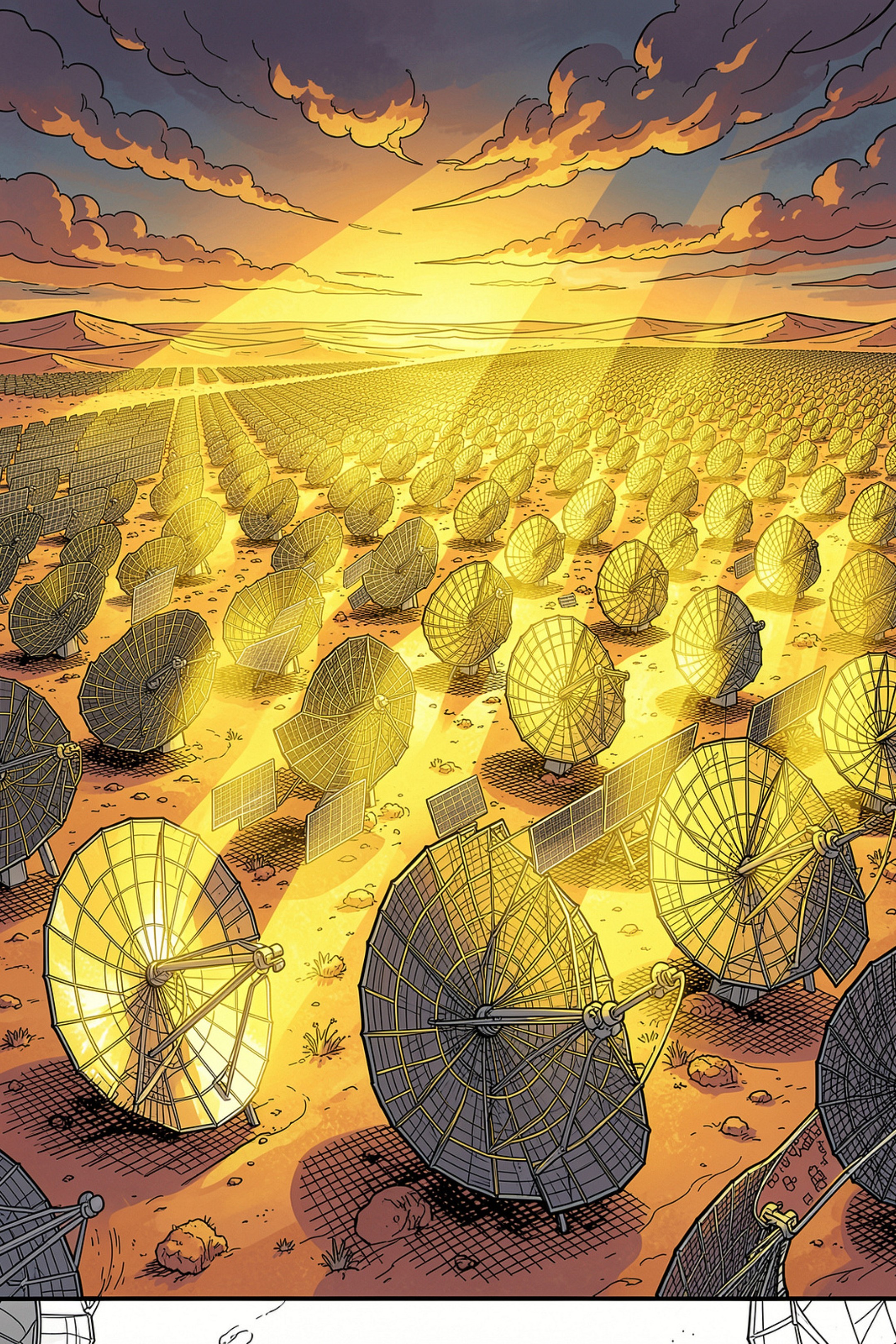
Imagen conceptual
What it is
An experimental architecture for managing solar energy
HeliosReflect investigates whether it is possible to capture solar radiation and distribute it simultaneously across different uses: electricity, industrial heat, light transport and photochemical processes. The core of this research is HR-DOC, an experimental optical architecture currently under mathematical and numerical validation.
The vision in detailWhy now
The tools already exist. The architecture is missing.
High-precision optical simulation, advanced materials and additive manufacturing have matured. What does not yet exist is a solar architecture conceived from the start to manage energy across multiple uses. That is the HeliosReflect research programme.
01
Optical simulation
Validation by tracing millions of rays.
02
Advanced materials
Reflectors resistant to concentrated radiation.
03
Artificial intelligence
Dynamic management of the energy split.
04
Precision manufacturing
Prototypes via additive manufacturing.
Why HeliosReflect?
Four reasons to research this
Current solar efficiency leaves much to explore
Photovoltaic panels convert approximately 20% of radiation. The rest is reflected or dissipated. Research in optical concentration opens new possibilities.
Solar energy can be used in more ways
Industrial heat, fibre optic light transport, photochemical reactors: solar concentration can power processes that today depend on other sources.
Classical physics allows it. Engineering must be validated
The focal property of the parabola is established science. The HR-DOC hypothesis applies this principle in a new way. Experimental validation will determine its real viability.
Open research advances faster
HeliosReflect is an open research platform for universities, technology centres and scientific collaborators worldwide.
Research lines
One architecture, multiple application hypotheses
HR-DOC is an experimental optical architecture. Four application lines are built on it. Each has a distinct maturity level, explicitly declared.
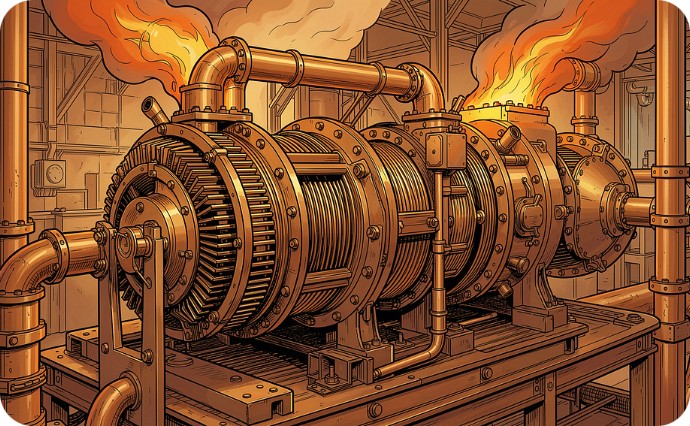
Stirling engine
Concentrated heat → electricity
Conversion of heat into electricity with 30-40% efficiencies. Mature, consolidated technology; its integration with HR-DOC is what must be validated.

Optical fibre transport
Light, not electricity
Transport photons to buildings, greenhouses and reactors using optical fibre, avoiding the double conversion light → electricity → light.

Artificial photosynthesis
Research hypothesis
Feed photochemical reactors with concentrated light to produce hydrogen, reduce CO₂ or synthesise solar fuels. HR-DOC does not perform the reaction: it only supplies the luminous flux.
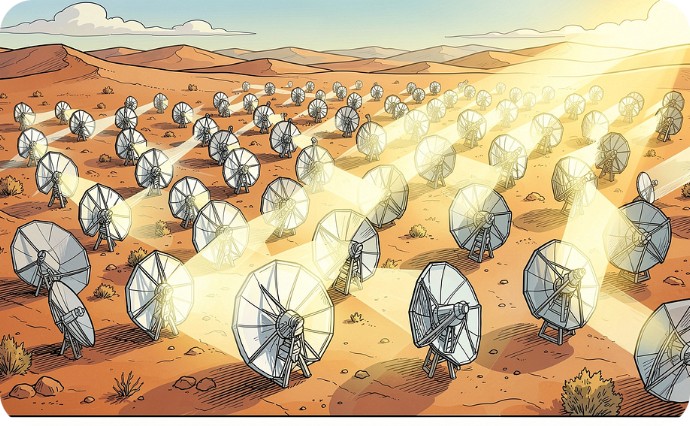
Climate regulation
Steerable mirrors · hypothesis
Deliberately reflect part of the radiation to manage the local radiative balance. Its effects can only be determined through climate simulations and experimental campaigns.
Project status
Where we are
Team
The people behind the project
Oriol Garcia Salas
Founder and lead researcher
Driving force behind the HeliosReflect research programme. Independent researcher focused on experimental solar optical concentration architectures and their multi-functional application.
Buscando investigadoras, investigadores y centros de I+D
We are actively seeking collaboration with researchers in optics, materials engineering, numerical simulation, photochemistry and systems control. If you lead a research group or belong to a technology centre, reach out.
Scientific rigour
Convince without exaggerating
At HeliosReflect we always distinguish between what is mathematically demonstrated, what is validated by simulation, what is being verified and what remains a hypothesis. Honesty about the level of evidence is a principle, not an option.
Visit the Transparency CenterResearch advances through collaboration.
Universities, technology centres, engineers, companies and investors: every discipline has a role in this programme.