
Science
A falsifiable research programme
HeliosReflect clearly distinguishes between classical results, derived results, hypotheses and results pending experimental validation. This distinction is the basis of all project communication.
Hypotheses
What we propose to investigate
Four main hypotheses and a general integration. Each has a declared status and a validation path.
HR-DOC
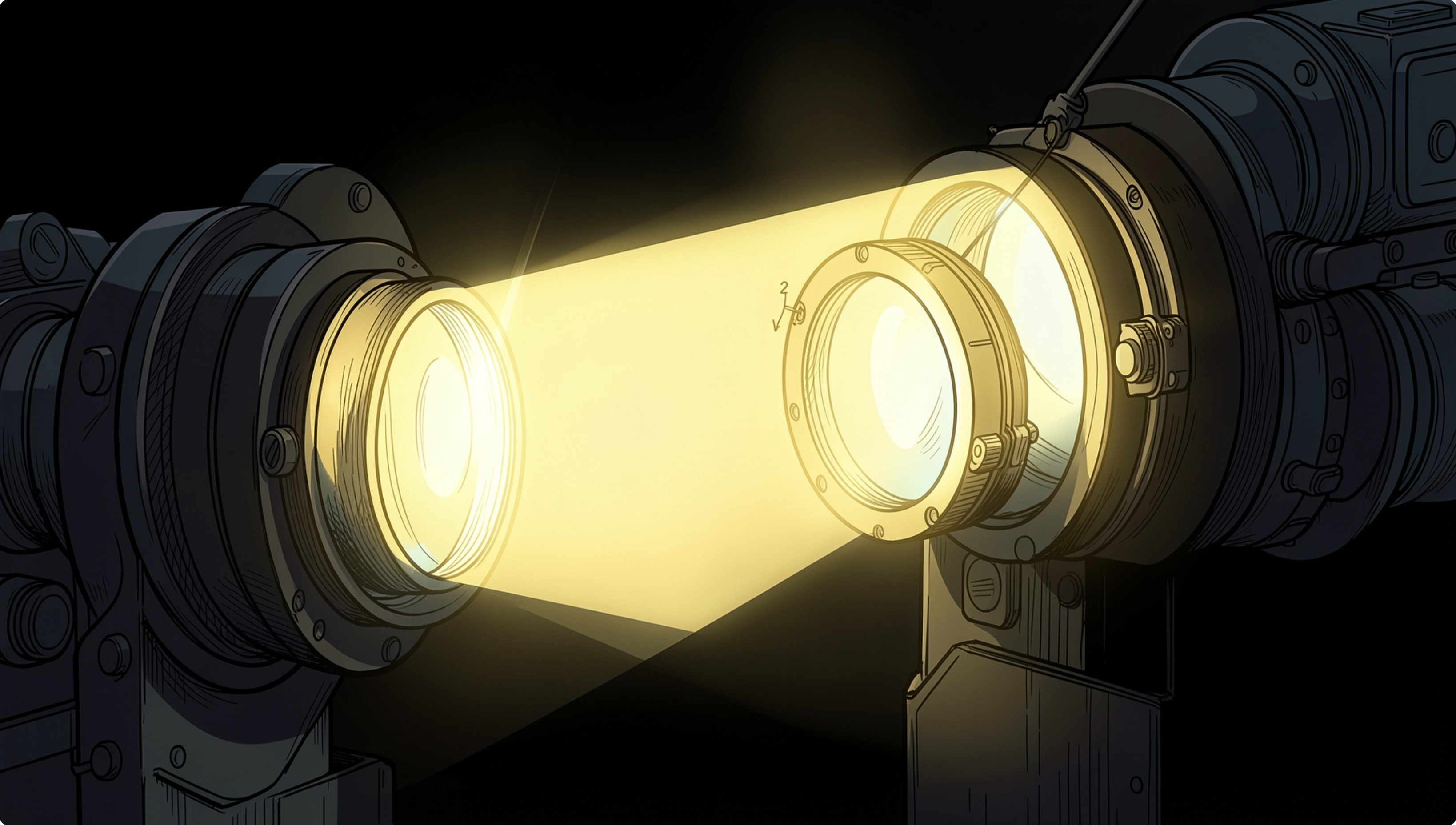
“Two confocal paraboloids transform parallel solar radiation into a concentrated parallel beam directed to a single receiver.”
Analytical proof, symbolic computation and Monte Carlo simulation completed. Experimental laboratory validation is still pending.
TRL: TRL 1-2
HR-Climate Mirror
“A system of steerable mirrors can partially manage the local radiative balance.”
Requires advanced climate modelling and experimental campaigns. It is not assumed that the net effect is positive: it is proposed to investigate it.
TRL: TRL 1
HR-Energy Split
“An intelligent management centre can distribute the captured energy among electricity, heat, light and chemical processes efficiently.”
Requires engineering analysis and detailed energy balances.
TRL: TRL 2-3
HR-PhotoSyn
“The platform can feed existing photochemical reactors with concentrated sunlight.”
It does not propose new chemistry: it proposes a light source. The integration must be validated with experimental reactors.
TRL: TRL 3-5 (field)
Integral architecture
“The six transformations can operate simultaneously and coordinated within the same infrastructure.”
Depends on the validation of the previous hypotheses.
TRL: Concept
Research areas
HR-DOC is a component, not the end goal. The project’s research areas are structured into six interdisciplinary lines.
Optics and solar concentration
High-efficiency concentration system design, reflector modelling, ray tracing and tolerance analysis.
- Geometrical optics
- Reflector design
- Ray tracing
Energy and thermodynamics
Closed-cycle engine integration, thermal storage, energy management and balance analysis.
- Stirling engines
- Thermal storage
- Energy management
Photonics and light transport
Launching and transporting concentrated light through optical fibres for natural lighting and processes.
- Power optical fibres
- Light guiding
- Natural lighting
Photochemistry and materials
Photochemical reactors, catalysts and artificial photosynthesis powered by concentrated sunlight.
- Photochemical reactors
- Artificial photosynthesis
- Materials science
Artificial intelligence and control
Intelligent solar tracking, dynamic energy splitting and whole-system optimisation.
- Predictive control
- Solar tracking
- Energy optimisation
Ecology and climate
Interaction with ecosystems, agrivoltaics, radiative balance and climate modelling.
- Agrivoltaics
- Radiative balance
- Climate modelling
Level of evidence
What is demonstrated and what is not
The project classifies every claim by its level of evidence, taking as reference the distinction established in the technical documents.
Demonstrated results
The focal property of the parabola, conservation of energy, conservation of étendue and the thermodynamic concentration limit are consolidated science. In addition, the theoretical validation of HR-DOC (analytical, symbolic and by simulation) is closed.
Partial validation
The validity of HR-DOC as a geometric optical system in its useful domain, with étendue conservation and no thermodynamic violation, has three independent verification paths. The experimental level is still missing.
Hypotheses
Integration with Stirling, high-power optical fibre transport, artificial photosynthesis and radiative balance management are hypotheses pending validation.
Awaiting experiments
Behaviour with real mirrors, manufacturing tolerances, real energy performance and full-scale applications are results that require experimentation.
Already done
What has already been validated (theoretical and numerical level)
- Analytical proof of the composite mapping of two confocal paraboloids with exact collimation in the useful domain.
- Symbolic verification with exact computation.
- Monte Carlo simulation with 200,000 rays: capture above 98 % for the real solar disc, collimation and magnification consistent with the model.
- Verification of étendue conservation and of the thermodynamic concentration limit.
- Identification and correction of geometric limits not foreseen in the initial design.
In progress
What is being validated now
- Independent optical simulation with external tools (tracing millions of rays).
- Parametric studies of manufacturing tolerances.
- Design of the laboratory experimental programme with seven tests.
- Development of the parametric CAD model of the first prototype.
Next level
Which experiments will be necessary
Experimental validation is the next frontier. A laboratory-scale programme will define whether the central hypothesis is supported by evidence.
One-metre prototype to test the HR-DOC hypothesis and characterise the beam.
Seven laboratory tests: geometric calibration, focus verification, secondary positioning, beam characterisation, temporal stability, influence of errors and comparison with simulations.
Measurement of irradiance, power, beam diameter, angular divergence and optical efficiency.
Systematic model-simulation-experiment comparison. No conclusion will be based on a single measurement.
The project is conceived as falsifiable: each hypothesis can be confirmed or refuted by evidence.
What is being validated now
Experimental validation is the next frontier. A laboratory-scale programme will define whether the central hypothesis is supported by evidence.